The word “paint” causes more industrial coating failures than any other single factor. It suggests one product applied to a surface, when what actually protects a structure is a system: a primer, sometimes an intermediate coat, and a topcoat, each chosen to do a different job and to work with the ones either side of it.
The substrate is the first question
Metal, steel, aluminum, concrete, brick and block all corrode differently, hold a coating differently and need different preparation. A system that performs on structural steel may fail on block within a season. Before anything else, a specification has to name what the surface actually is, including whatever coating is already on it.
Then the exposure
In an industrial plant the focus is on protecting equipment and structures from corrosion and wear, which means the coating is chosen for what it has to survive:
- Chemical exposure. Process chemicals, cleaning chemicals, and the difference between splash and immersion.
- Wash-down. Frequent water and detergent, which rules out a lot of otherwise durable systems.
- Heat. Both operating temperature and thermal cycling, which is harder on a coating than steady heat.
- Abrasion and impact. Forklift contact, foot traffic, tools, product.
- UV. Relevant on exteriors and on anything near daylight, and a common reason epoxy is not the right topcoat outdoors.
What each layer does
The primer is about adhesion and corrosion resistance. It bonds to the prepared substrate and forms the barrier that keeps moisture off the steel. The topcoat is about the environment: chemical resistance, abrasion, color, cleanability. On equipment we generally use epoxy for its hardness and chemical durability. On surfaces that see sunlight, a polyurethane topcoat over an epoxy primer is often the better combination, because epoxy chalks in UV.
Getting the layers wrong in either direction costs money. A premium topcoat over a primer that will not hold is wasted. A cheap topcoat over a good primer fails first and takes the system with it.
Surface preparation is part of the specification
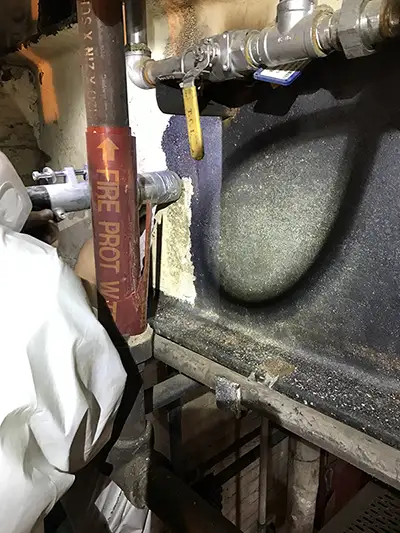
A coating system is only as good as what it is applied to. The specification should state the level of preparation required, not just the tool, and it should be matched to the substrate: needle guns and rotary scalers where there is heavy corrosion or failed coating, dry ice blasting or pressure washing where cleaning rather than profiling is what is needed.
Most premature failures trace back to this step rather than to the paint.
What a good specification states
- The substrate and its current condition
- The preparation standard required
- Each coat: product type, and the dry film thickness expected
- The environment the system is being chosen for
- Conditions for application, including temperature and humidity limits
- What is excluded, and what is being masked rather than coated
The cheapest system is rarely the cheapest outcome. A system specified properly and applied once outlasts two cycles of the alternative.
See our industrial painting services, read about surface preparation, or ask us to specify a system.