Ask three contractors for an epoxy floor and you may get three different systems, all correctly described as epoxy. The word has become a generic term for many types of resin flooring, which makes it almost useless for comparing quotes.
What epoxy actually is
Strictly, epoxy is the fully cured result of two components or resins that have been mixed. It has been used for many years and is known for its adhesive qualities, which is the property that matters most in flooring.
In a floor system it turns up in three distinct roles:
- Crack repair, filling and bridging defects in the slab
- Primer systems, bonding the build-up to the concrete
- Final top coats for floors and surfaces
It can be clear or supplied in a wide assortment of colors, which is why it reads as a decorative product when it is mostly a structural one.
Solids content
An epoxy primer coat can be solids-based or water-based. For thicker applications, 100 percent solids epoxy is usually the suitable choice, because it cures fast and gives absolute strength. Lower solids products have their place, generally where penetration into the slab matters more than film build.
This is worth asking about, because two quotes both saying “epoxy primer” can mean very different products.
Where polyurethane and polyaspartic come in
Epoxies are often used as the bond coat for subsequent top coats, either of similar material or of something with higher abrasion and chemical resistance, such as polyurethane or polyaspartic coatings.
So on many industrial floors the epoxy is not the layer you walk on at all. It is the layer holding the system to the slab, with a tougher and more UV-stable topcoat above it. That matters in areas with daylight, because epoxy chalks under UV, and in areas with heavy chemical exposure or vehicle abrasion.
How to read a floor specification
A system, not a product. A proper specification names each layer:
- Slab preparation standard, whether grinding, shot blasting or acid etching
- Crack and defect repair
- Primer, with its type and solids content
- Body coats, with the number of coats
- Topcoat, chosen for the actual exposure in that area
- Additives, such as anti-slip aggregate where it is needed
If a quote gives a price per square foot and the word “epoxy”, ask for this breakdown before comparing it with anything.
What the finished system gives you
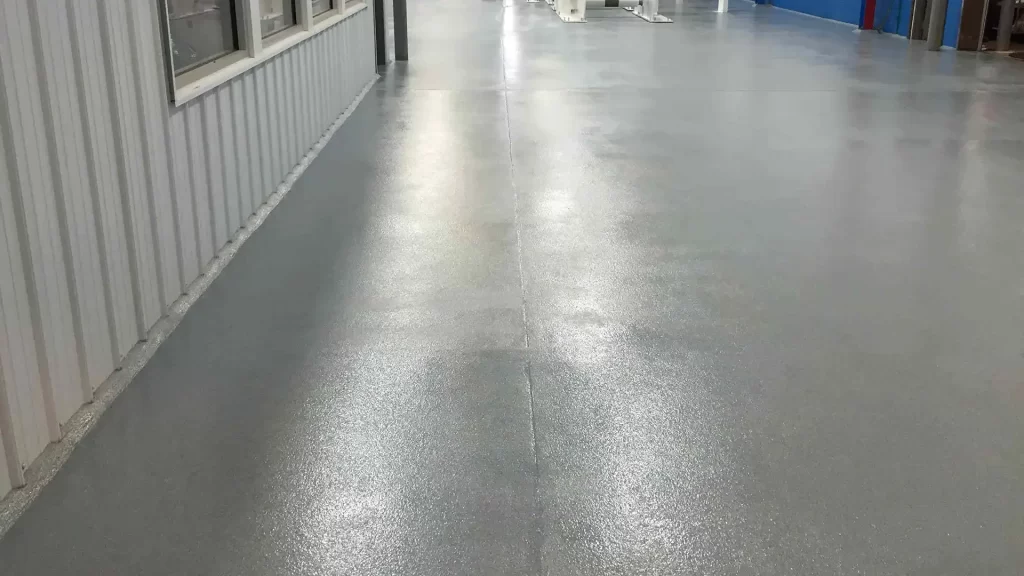
Seamless and easy to clean with a mop and light detergent. Hard, durable and wear-resistant under vehicle traffic. Customizable in color and pattern. Slip resistant where anti-slip additives are specified. Available in low or no VOC formulations. Fast curing, with curing times that can be adjusted for cold or hot applications.
Read more about epoxy floor coatings and surface preparation, or get a quote for your floors.


